In modern industrial waste management, contamination is the silent killer of circular economy economics. When post-consumer paper is mixed with wet cafeteria food residuals, or when rigid PET containers are cross-contaminated with lubricating greases, the energetic and economic burden required to restore those materials to manufacturing-grade purity escalates exponentially.
1. The Chemistry and Thermodynamics of Stream Contamination
Cellulosic fibers in corrugated cardboard and office ledger paper rely on hydrogen bonding to maintain tensile strength. When exposed to oils, moisture, or organic starches, these fibers weaken permanently. In mechanical repulping mills, contaminated paper yields up to 40% fiber loss as sludge, requiring significant caustic chemical treatments and additional freshwater rinsing.
Similarly, polymer recycling faces severe thermal degradation when dissimilar resins are commingled. Polyethylene Terephthalate (PET) melts at approximately 250°C to 260°C. If contaminated with even 0.5% Polyvinyl Chloride (PVC), the PVC degrades at PET processing temperatures, releasing corrosive hydrochloric acid (HCl) gas that chars the resin, pits the extruder barrels, and turns transparent bottle-grade flakes into brittle brown scrap.
2. The Multi-Stream Bin Infrastructure Architecture
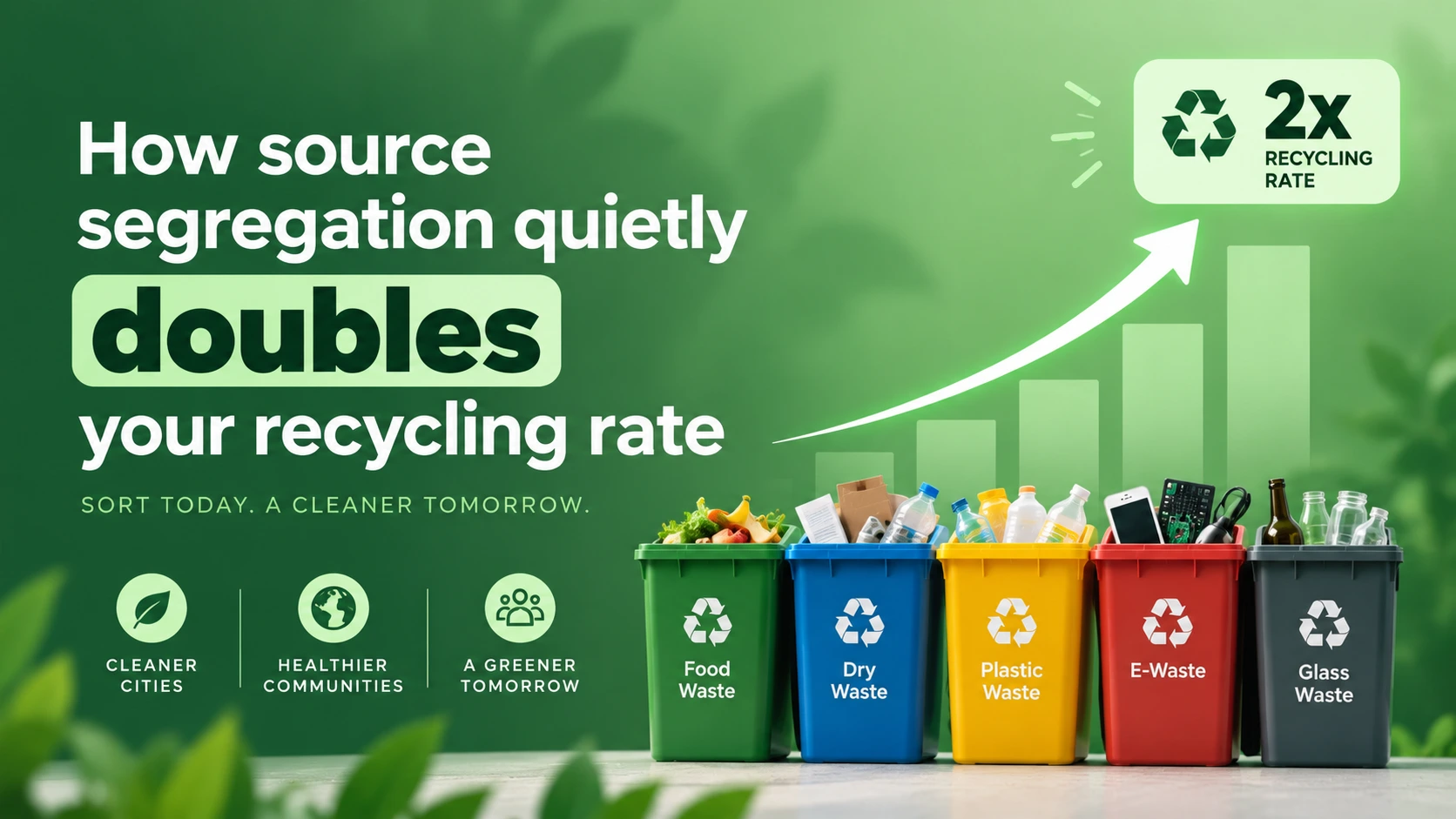
At TOT Environ, we advise facilities to abandon generic two-bin configurations in favor of a specialized four-stream color-coded system:
- Clean Dry Paper & Fiber: OCC cardboard, office records, cartons.
- Dry Rigid & Film Polymers: PET bottles, HDPE jugs, PP containers, LDPE wrap.
- Organic & Wet Residuals: Cafeteria food scraps, pantry remnants, coffee grounds.
- Regulated & Electronic Streams: Batteries, cables, fluorescent bulbs, electronic assets.
3. Financial Payback: Slashing Carting Surcharges
Facilities that implement rigorous source segregation protocols capture immediate financial returns. Segregated dry recyclables command premium commodity off-take revenues from recyclers rather than incurring tipping fees. Furthermore, diverted wet waste can be converted to compost on-site, eliminating high-volume municipal haulage charges.